Compass Plant
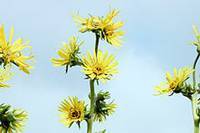
The common name compass plant was inspired by the "compass orientation" of its leaves. The large leaves are held vertically with the tips pointing north or south and the upper and lower surfaces of the blades facing east or west. A newly emerging leaf grows in a random direction, but within two or three weeks it twists on its petiole clockwise or counterclockwise into a vertical position. Studies indicate that the sun's position in the early morning hours influences the twisting orientation. This orientation reduces the amount of solar radiation hitting the leaf surface. Vertical leaves facing east-west have higher water use efficiency than horizontal or north-south-facing blades.
Early settlers on the Great Plains could make their way in the dark by feeling of the leaves.